
Drain Field & Leach Field Service
in Ventura County
Your drain field is the part of the septic system that does the real treatment work — and when it fails, the whole system backs up. Busy Bee diagnoses, repairs, rejuvenates, and replaces leach fields across Ventura County, from a single clogged line to a complete rebuild.
Request a Free Estimate
Get a fast response for your Drain Field & Leach Field Service
Why Ventura County Homeowners Call Busy Bee for Leach Field Problems
Most drain-field failures are misdiagnosed as tank problems, and most tank pump-outs do nothing for a failing field. We start with the field itself — camera inspection, soil evaluation, and a perc test — so the fix matches the real cause instead of the symptom.
Real Diagnosis First
Camera inspection, locating equipment, and soil evaluation show whether the problem is a clogged line, a failed distribution box, biomat buildup, or soil that no longer percolates.
Repair Before Replace
Many leach fields can be saved. Jetting, distribution-box repair, and rejuvenation often restore a field at a fraction of the disruption of a full replacement.
Soil-First Design
Ventura County soil ranges from sandy loam to heavy clay and rocky hillside ground. We rebuild drain fields to match the soil they sit in, not a one-size-fits-all template.
Permits and Paperwork
Leach field replacement needs county approval. We handle the application with Ventura County Environmental Health and coordinate the inspections that close the permit.
What Is a Leach Field, and How Does It Work?
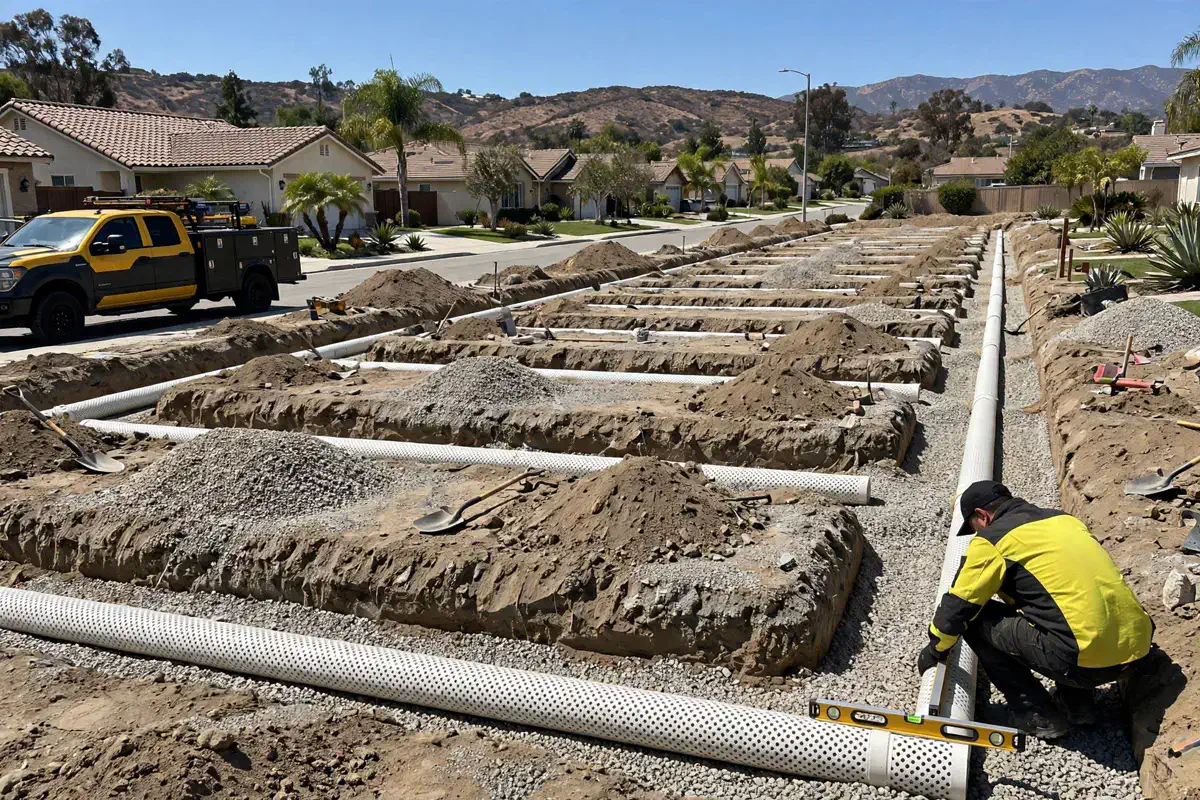
A leach field — also called a drain field — is the shallow network of buried trenches that finishes treating your household wastewater after the septic tank has done the first stage. Wastewater flows from your home into the septic tank, where solids settle as sludge and oils float as scum. The clarified liquid in the middle, called effluent, flows out through the outlet baffle and into a distribution box. The distribution box, or D-box, splits the effluent evenly between several perforated leach lines laid in gravel-filled trenches. From there the effluent seeps out through the holes in the pipes, trickles through the gravel, and percolates slowly down through the soil. That slow journey through soil is the treatment: soil microbes break down remaining contaminants before the water reaches groundwater. A healthy leach field is invisible — no odor, no wet spots, no lush stripes of grass.
Leach fields fail gradually, and the warning signs show up in the yard and the house long before sewage surfaces. Standing water or soggy ground over the drain field, especially when it has not rained, means effluent is no longer percolating downward. A sewage odor in the yard, slow drains throughout the house, gurgling toilets, and repeated backups all point the same way. So do bright green strips of grass growing in straight lines over the leach trenches: the grass is feeding on effluent pooling just below the surface. In the worst cases, sewage itself surfaces in the yard. Any of these signs deserves a prompt inspection, because a struggling field caught early can often be saved, while one that is ignored usually needs a full replacement.
The most common cause of leach-field failure is biomat — a slimy layer of bacteria and organic matter that builds up where effluent meets the soil. A thin biomat is normal and even useful, because it helps filter the effluent. But when a tank is pumped too rarely, or when too much water is sent through the system at once, the biomat grows thick, seals the soil, and blocks percolation. Other causes include a cracked or tilted distribution box that sends all the effluent down one line while the others sit dry, crushed or root-invaded leach lines, and soil that was never suited to the load. Heavy vehicles or structures parked over the field compact the soil and crush the pipes, and a field undersized for the household will fail years before its time.
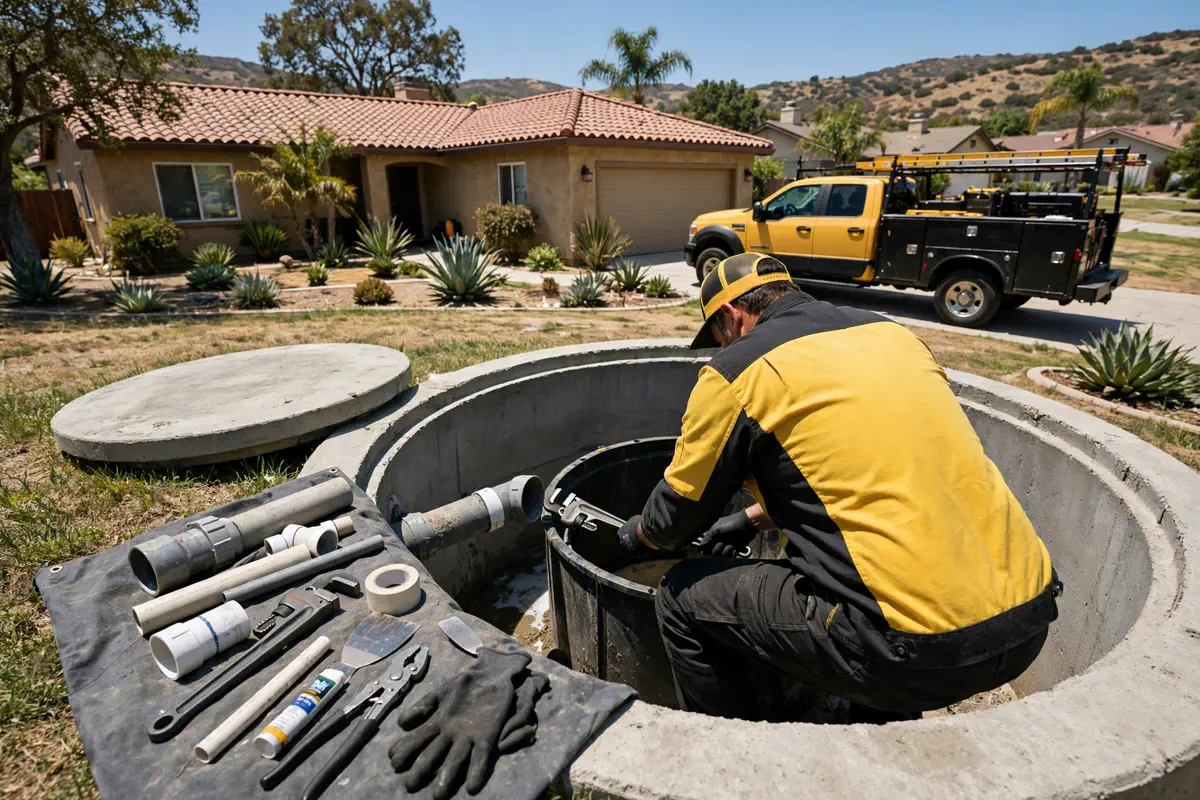
When a leach field can be saved, rejuvenation is the gentlest fix. We start by pumping the tank and checking the effluent filter and baffles, because a field cannot recover while the tank keeps sending solids downstream. Then we jet the leach lines with high-pressure water to break up biomat and clear sludge from the perforated pipes, and we repair or level the distribution box so every line receives an equal share of effluent again. In some cases we rest one section of the field while the other carries the load, giving the soil time to dry and the biomat time to break down naturally. A perc test after jetting tells us whether percolation has recovered enough for the field to keep working, or whether the soil is permanently sealed.
When rejuvenation is not enough, the choice is repair versus replacement, and the right answer depends on what the diagnosis found. A single crushed or root-blocked line can be repaired or replaced on its own, and a tilted distribution box can be re-leveled or swapped out. But when the perc test shows the soil itself no longer absorbs water, or when most of the lines are collapsed, a partial or full drain-field replacement is the honest fix. Replacement means new trenches in fresh soil, new leach lines and gravel, a new distribution box, and in some lots seepage pits to add percolation capacity where shallow trenches cannot do the job alone. We lay out both options — what each involves, what each lasts, and what affects the cost — so you can decide with real information instead of pressure. Replacement in Ventura County requires a permit from Ventura County Environmental Health, and we prepare the application and coordinate the open-trench inspection.
- Standing water or soggy ground over the drain field when it has not rained.
- Sewage odors in the yard, or gurgling and slow drains inside the house.
- Bright green strips of grass growing in straight lines over the leach trenches.
- Repeated backups that return soon after the tank is pumped.
- Sewage surfacing in the yard — call immediately and keep people and pets away.
A Failing Leach Field: Waiting or DIY vs. Busy Bee
A drain field cannot be fixed with additives or a pump-out alone. Here is what happens when the problem is left alone — and what a proper leach-field service does instead.
| Service Aspect | Waiting or DIY | Busy Bee Septic |
|---|---|---|
| Diagnosis | The tank is pumped again and again while the real problem in the field goes unexamined. | ✓ Camera inspection, locating, and a perc test pinpoint whether the fault is biomat, a line, the D-box, or the soil. |
| Unclogging the field | Additives and chemicals are poured in, which do not remove biomat and can harm the soil biology. | ✓ High-pressure jetting clears biomat and sludge from the leach lines, and the distribution box is re-leveled. |
| Repair vs. replacement | The whole field is assumed dead, or the failure is patched over until sewage surfaces. | ✓ We repair single lines or the D-box when that is enough, and replace the field only when the soil demands it. |
| Permits and inspections | Replacement work goes in without county approval, creating problems at inspection and at sale. | ✓ We submit the replacement design to Ventura County Environmental Health and pass the open-trench inspection. |
| Protecting the new field | The tank keeps sending solids downstream, so the new field starts clogging from day one. | ✓ We check baffles and the effluent filter, set a pumping schedule, and fit risers for easy future service. |
How Leach Field Service With Us Works
From the first sign of trouble to a field that drains properly again — four steps, no guesswork.
Call
Call (805) 307-3409 any time, day or night. Describe the signs — wet spots, odors, slow drains, surfacing sewage — and we will schedule an inspection.
Free Estimate
We inspect the tank, the distribution box, and the leach lines, run a perc test where needed, and give you a free estimate that explains the cause and your options.
On-Time Service
Our crew arrives on schedule to jet, repair, or replace the field, handling county permits and inspections when the job requires them.
Done Right
We restore the yard, verify the field is percolating, and leave you with a pumping schedule and simple care steps that protect the field for years.
Is Your Leach Field Failing? Get Answers Today.
Call Busy Bee Septic Tank Pumping at (805) 307-3409. We will inspect your drain field, explain what is wrong in plain language, and give you a free estimate for the fix.
Request Your Free EstimateFrequently Asked Questions
Find immediate answers about this septic service in Camarillo and Ventura County.
Can a leach field be unclogged? +
How long does a leach field last? +
What causes a leach field to fail? +
Should I repair or replace my leach field? +
Do I need a permit to replace a leach field in Ventura County? +
What are the signs of leach field failure? +
Busy Bee Septic Tank Pumping
Areas We Serve in Ventura County
From our Camarillo base at 465 Carmen Dr, we service drain fields and leach fields across Camarillo, Ventura, Oxnard, Thousand Oaks, Simi Valley, Moorpark, Santa Paula, and Fillmore — the whole of Ventura County.