
Septic Inspection
in Ventura County
Buying a home, selling one, or just want to know where your system stands? Our septic inspection covers the tank, the baffles, the effluent filter, and the drain field — and ends with a clear written report you can act on.
Request a Free Estimate
Get a fast response for your Septic Inspection
Why Ventura County Trusts Busy Bee for Septic Inspections
An inspection is only useful if it is thorough and honest. We look at the whole system, measure what can be measured, test what can be tested, and write down what we find — good and bad.
A Written Report You Can Use
You receive a clear report on the tank, baffles, filter, and drain field, with photos of what we found and plain-language recommendations.
Built for Home Sales and Escrow
We work on escrow timelines, coordinate with agents and buyers, and deliver the documentation a sale needs, without delay.
Tank, Lines, and Drain Field
We check sludge and scum levels, baffles, the effluent filter, riser lids, and the drain field, and we use a dye test and camera scope when the situation calls for them.
Open 24 Hours
Routine inspections on your schedule and fast response when a sale or a backup cannot wait. Call any time, day or night.
What Is Included in a Septic Inspection
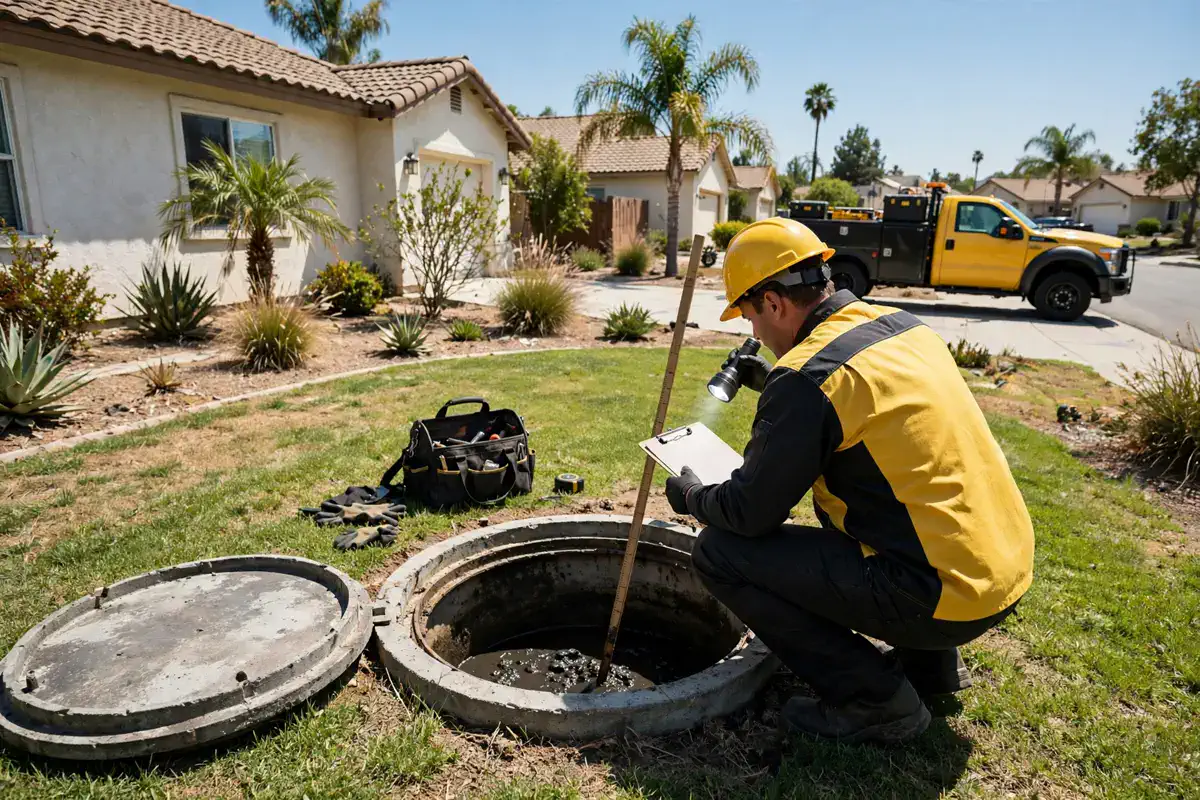
A septic inspection is a structured examination of the entire onsite wastewater system, from the house to the soil. It starts with locating the tank and uncovering the access points. Our inspector opens the riser lids and measures the sludge layer at the bottom and the scum layer at the top, because those two measurements say more about the condition of the system than anything else. We also check the liquid level: a level above the outlet pipe can indicate a drain field that is not absorbing, while a very low level can point to a crack or a leak in the tank.
With the tank open, we inspect the parts that protect the drain field. The inlet and outlet baffles direct flow and keep solids in the tank; a cracked, missing, or deteriorated baffle lets solids escape. The effluent filter, fitted at the outlet, catches floating debris before it reaches the leach lines; a clogged filter slows the whole system, while a missing one leaves the drain field unprotected. We check the tank walls, the riser lids, and the access ports for root intrusion, corrosion, or structural damage, and every finding goes into the written report with photos where they help.
The drain field gets its own attention. We walk the absorption area looking for soggy ground or standing water when it has not rained, sewage odors, unusually lush strips of grass over the leach lines, and any sign of effluent surfacing. We check the distribution box — the D-box — where accessible, because a tilted or damaged box sends too much effluent to one line and starves the others. When the situation calls for it, we run a dye test, introducing a harmless tracer dye and watching for it to surface, or a camera inspection to scope the lines for roots, cracks, bellies, and blockages.
A septic inspection is most commonly ordered when a home is being bought or sold. The buyer is about to inherit a system buried in the yard, and an inspection before listing, or early in escrow, gives both sides the facts: the tank size in gallons, the condition of the baffles and filter, the pumping history, and the state of the drain field. If the system is sound, the report supports the sale. If it needs work, the parties can agree on a repair, a credit, or a price adjustment before closing. We coordinate with real estate agents and work to escrow deadlines.
Ventura County regulates onsite wastewater treatment systems — OWTS — through the Environmental Health Division, under the county Local Agency Management Program, known as the LAMP. The LAMP sets the rules for how septic systems are designed, installed, repaired, and replaced, including permits for new systems and major repairs. A new installation or a significant repair generally requires a permit and a county inspection, and the system must meet current standards for tank size, setbacks, and soil absorption. The septic vent matters too: it usually rises through the roof, letting sewer gases escape safely while keeping drain pressure balanced, and a blocked vent can cause gurgling drains and odors that mimic a full tank. Inspection cost depends on scope and access.
- Locate the tank and open the riser lids or access ports
- Measure sludge and scum levels and check the liquid level
- Inspect baffles, effluent filter, tank walls, and riser lids
- Walk the drain field for wet spots, odors, and surfacing effluent
- Run a dye test or camera inspection when the situation calls for it
- Deliver a clear written report with photos and recommendations
Guessing vs. a Professional Inspection
A septic system is buried, so guessing is expensive. Here is what an inspection changes.
| Service Aspect | Waiting or DIY | Busy Bee Septic |
|---|---|---|
| What you know | You know the drains are slow or the yard smells, but not why. | ✓ Measured sludge and scum levels, baffle and filter condition, and a drain field assessment, in writing. |
| Home sale risk | A buyer discovers a failing system late in escrow, and the deal stalls. | ✓ Problems are found early, so repairs or credits are agreed before closing. |
| Hidden damage | Cracked baffles, a missing filter, or a tilted box stay hidden until the field fails. | ✓ Dye tests and camera inspection reveal what is happening underground, before it becomes a failure. |
| Maintenance plan | Pumping happens on a guess, or only after a backup. | ✓ Your pumping schedule is set from real measurements, based on your system. |
| County requirements | You learn about permits and LAMP rules only when a repair is already urgent. | ✓ We explain the general county requirements that apply, so you can plan ahead. |
How a Septic Inspection Works With Us
Four simple steps, from your first call to a report you can rely on.
Call or Request a Quote
Call (805) 307-3409 or send a quote request. Tell us if the inspection is for a home sale, escrow, or routine check, and share any deadlines.
Get a Free Estimate
We explain the inspection scope — basic inspection, dye test, camera scope, or pumping in the same visit — and what affects the cost.
On-Time Service
Our inspector arrives on schedule, locates the tank, measures and tests the system, and documents everything with photos.
Done Right
You receive a clear written report with findings and recommendations, explained in plain language, on your escrow timeline.
Need a Septic Inspection for a Home Sale — or Just Peace of Mind?
Call Busy Bee Septic Tank Pumping for a free estimate. We inspect homes across Ventura County, work to escrow deadlines, and deliver a written report you can act on. Open 24 hours.
Request Your Free EstimateFrequently Asked Questions
Find immediate answers about this septic service in Camarillo and Ventura County.
Can you sell a house with a non-compliant septic tank? +
How much does a typical septic inspection cost? +
How often does a 1000 gallon septic tank need to be pumped? +
Where should a septic vent be located? +
What does a septic inspection include? +
How long does a septic inspection take? +
Busy Bee Septic Tank Pumping
Areas We Serve in Ventura County
From our Camarillo base at 465 Carmen Dr Ste C, we serve homes and businesses across Ventura County, including Camarillo, Ventura, Oxnard, Thousand Oaks, Simi Valley, Moorpark, Santa Paula, and Fillmore — day and night, seven days a week.