
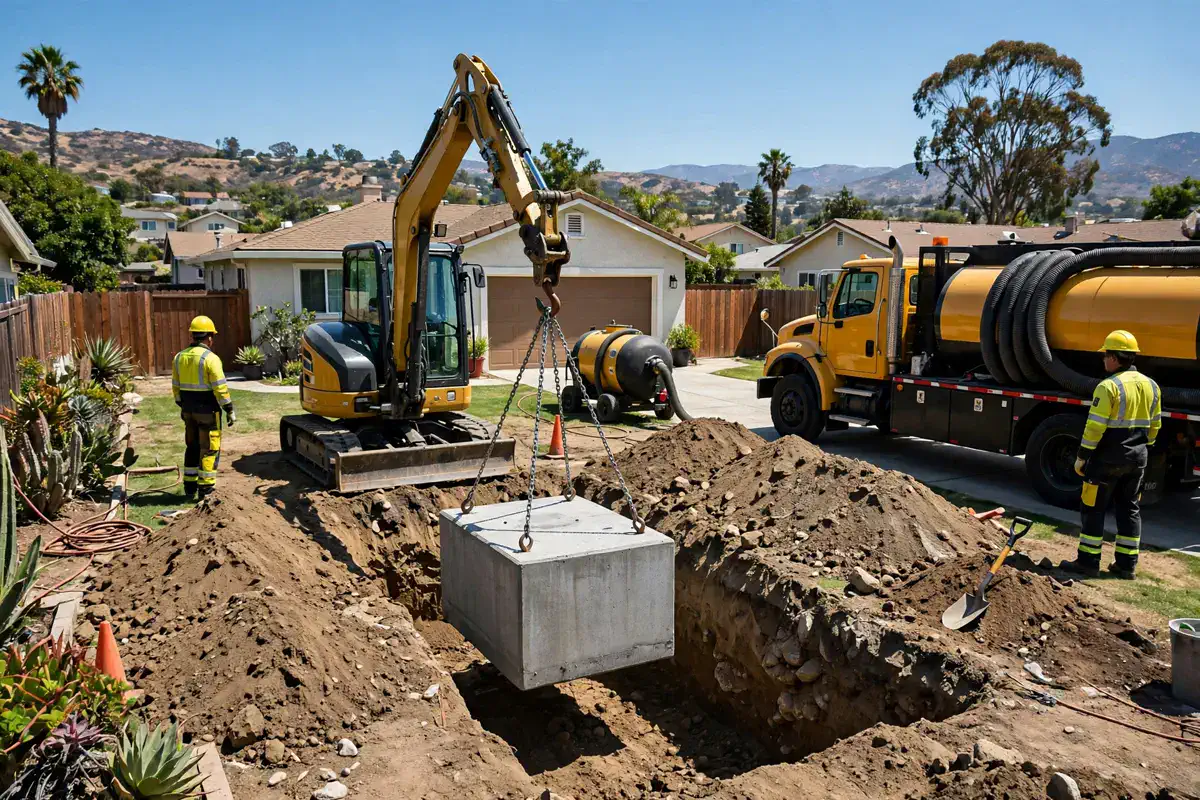
Septic System Installation
in Ventura County
A new septic system is a major investment, and it has to be done right the first time. Busy Bee designs and installs complete systems across Ventura County — tank, drain field, seepage pits, and risers — with permits handled and inspections passed.
Request a Free Estimate
Get a fast response for your Septic System Installation
Why Homeowners Choose Busy Bee for Septic Installation
Installing a septic system means excavation, permits, soil testing, and work that stays buried for decades. Our Camarillo crew handles design, county approvals, installation, and final inspection — one team from the first visit to the last sign-off.
Permits Handled for You
We prepare the site plan, coordinate the perc test, and submit the application to Ventura County Environmental Health, so your installation moves through approval without delays.
Built Right the First Time
Correct tank sizing, proper drain-field layout, and careful backfill protect your system for decades. We install to county code — no shortcuts buried underground.
Local Soil Know-How
Ventura County soil varies from sandy loam on the Oxnard Plain to rocky hillside ground in the Conejo Valley. We design each system for the soil and lot it actually sits on.
Free Estimates, Clear Answers
Every installation starts with a free on-site estimate and a plain explanation of what your property needs, what the work involves, and what affects the cost.
How Septic System Installation Works
A septic system treats your household wastewater on your property, with no connection to a city sewer. Wastewater flows into a buried septic tank, where solids settle as sludge and oils float as scum. Baffles hold those layers in place while the clarified liquid in the middle — called effluent — flows out to the drain field. There, perforated leach lines spread it through gravel trenches, and the soil filters it as it percolates downward.
Every installation starts with a site evaluation. We walk the property with you, locate the existing system if there is one, and check slope, usable area, and setbacks from wells, property lines, and structures. Then comes the percolation test, or perc test: test holes are dug in the proposed drain-field area and filled with water to measure how fast the soil absorbs it. Ventura County Environmental Health uses those results, plus the bedroom count, to set the drain-field size and the type of system your lot can support.
With the perc results in hand, we design the system and submit the permit application to Ventura County Environmental Health. The design covers the tank size in gallons, the drain-field layout, the distribution box that splits effluent evenly between leach lines, and any seepage pits or risers the site needs. In California, septic system installation falls under the C-42 sanitation system license classification, and the work must meet the county Local Agency Management Program, or LAMP, and the state Onsite Wastewater Treatment System, or OWTS, standards.
Once the permit is approved, excavation begins. We dig the tank hole and the drain-field trenches, set the tank level on a prepared bed, and connect the inlet and outlet pipes. The drain field goes in next: perforated leach lines laid in gravel-filled trenches, connected through a distribution box so each line receives an equal share of effluent. On lots where the soil or space calls for it, we install seepage pits — deep, lined pits that give wastewater extra room to percolate. Septic tank risers are fitted at the same time, bringing the tank lids up to ground level.
Before anything is buried, the county inspector reviews the open excavation, the tank setting, and the drain-field layout. Only after that inspection passes do we backfill, grade the area, and restore the surface, and a final inspection closes the permit. A new system is also the right moment to fix problems hiding in the old one: with camera inspection and locating equipment, we map the old drain field and confirm whether the failure was in the tank, the field, or the soil. And if you are buying or selling a home, we perform septic inspections for home sales — tank location, lids and risers, sludge and scum levels, baffles, the effluent filter, the drain field, and a dye test or camera scope where needed.
- Site evaluation: walk the lot, check slope, setbacks, and usable area.
- Perc test: measure how fast the soil absorbs water to size the drain field.
- Design and permits: submit the system design to Ventura County Environmental Health.
- Excavation and tank setting: dig, level the bed, set the tank, connect the piping.
- Drain field and seepage pits: lay leach lines through a distribution box; add seepage pits where needed.
- Risers and inspection: fit risers to grade, pass the county inspection, then backfill and grade.
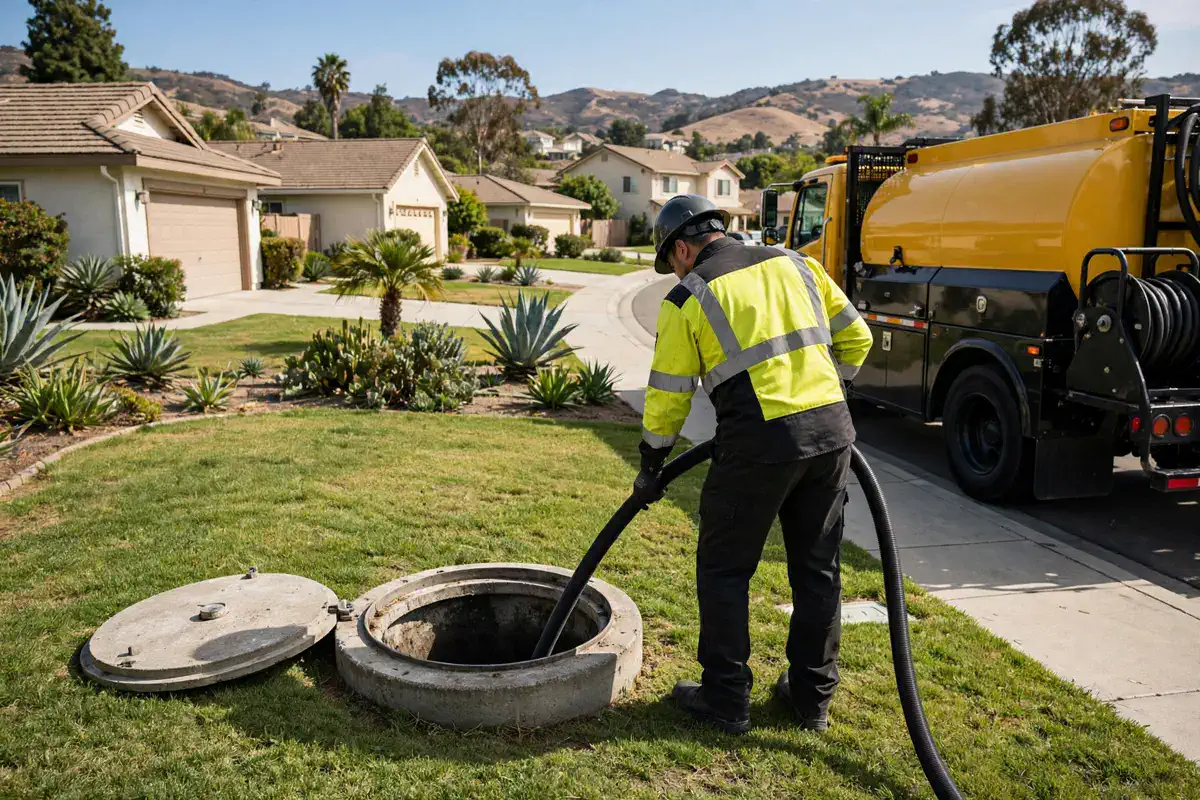
Installing a New Septic System: Waiting or DIY vs. Busy Bee
A septic system is buried infrastructure that must pass county inspection and last for decades. Here is how a professional installation compares with putting the job off or attempting it without a licensed crew.
| Service Aspect | Waiting or DIY | Busy Bee Septic |
|---|---|---|
| Permits and approvals | Permit applications, perc tests, and county inspections are left to the homeowner to figure out. | ✓ We prepare the design, coordinate the perc test, and submit the permit to Ventura County Environmental Health. |
| System design | Tank size and drain-field layout are guessed, risking an undersized system that fails early. | ✓ Tank size, leach lines, and distribution box are sized from perc results and bedroom count. |
| Drain field and seepage pits | Leach lines and seepage pits go in without soil data, so effluent has nowhere to go. | ✓ Drain field, seepage pits, and risers are built to match your soil, lot, and county requirements. |
| Inspection and sign-off | Open-trench and final inspections fail, and the system cannot legally be used until they pass. | ✓ We schedule county inspections, pass the open-trench review, and close the permit with a final sign-off. |
| Records for the future | No as-built record exists, so the next buyer or contractor must locate everything from scratch. | ✓ You receive a record of tank size, drain-field layout, and the pumping schedule your system needs. |
How Installing a Septic System With Us Works
Four simple steps take you from a failing or missing system to a permitted, inspected installation that is ready to use.
Call
Call (805) 307-3409 any time — we answer around the clock. Tell us about your property, your timeline, and whether this is new construction or a replacement system.
Free Estimate
We visit the site, evaluate the lot, review the perc test needs, and give you a free written estimate that explains the work, the permits, and the cost factors involved.
On-Time Service
Once the permit is approved, our crew arrives on schedule, excavates, installs, and coordinates the county inspections — keeping you updated at every stage.
Done Right
We backfill, grade, and restore the site, pass the final inspection, and walk you through your new system and its maintenance schedule before we leave.
Planning a New Septic System in Ventura County?
Call Busy Bee Septic Tank Pumping at (805) 307-3409 for a free on-site estimate. We will evaluate your lot, explain the permit process, and design a system built to last.
Request Your Free EstimateFrequently Asked Questions
Find immediate answers about this septic service in Camarillo and Ventura County.
Can you legally install your own septic tank in California? +
What permits are needed for a septic system installation in Ventura County? +
How long does a septic system installation take? +
What is a perc test, and why does my installation need one? +
What affects the cost of a new septic system installation? +
Do you install seepage pits and septic tank risers? +
Busy Bee Septic Tank Pumping
Areas We Serve in Ventura County
From our Camarillo base at 465 Carmen Dr, we install septic systems across Camarillo, Ventura, Oxnard, Thousand Oaks, Simi Valley, Moorpark, Santa Paula, and Fillmore — the whole of Ventura County.