
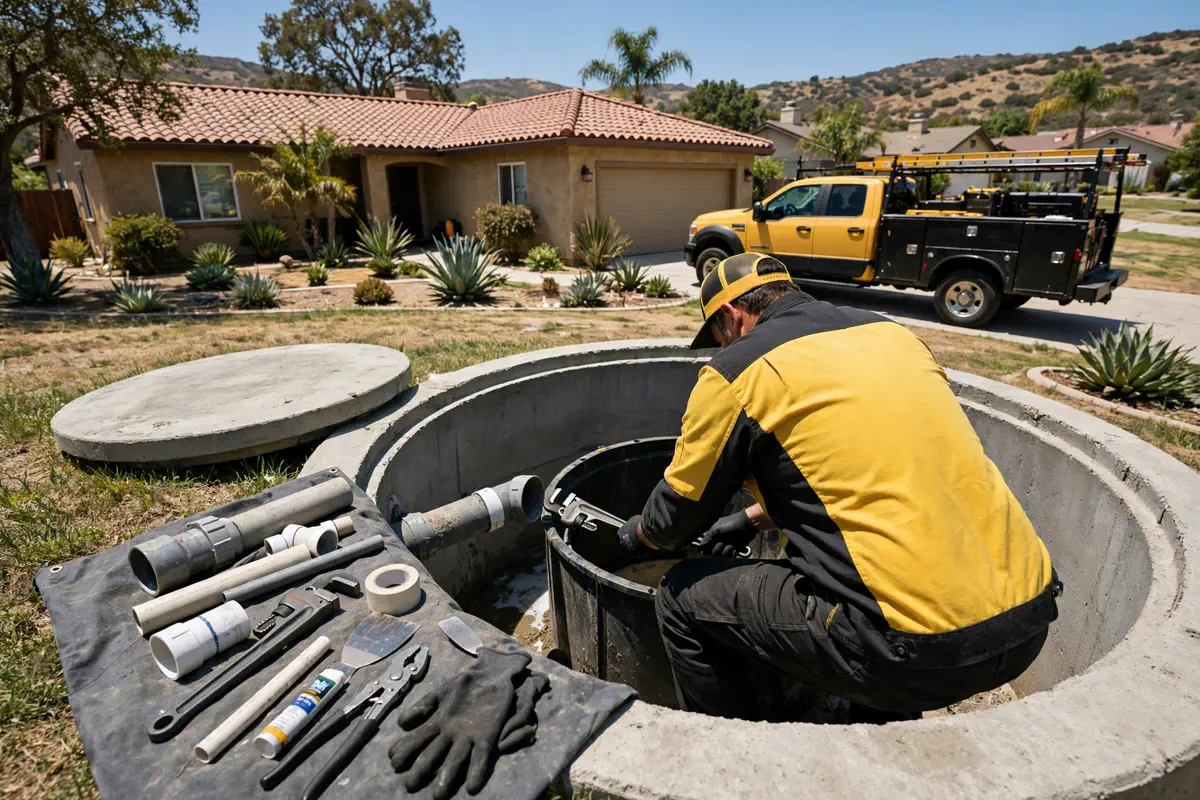
Septic System Repair
in Ventura County
Slow drains, sewage odors, a soggy yard, or a backup in the house — a septic problem only gets more expensive while it waits. Busy Bee finds the real cause, repairs what can be repaired, and tells you honestly when replacement is the smarter choice.
Request a Free Estimate
Get a fast response for your Septic System Repair
Why Ventura County Calls Busy Bee for Septic Repair
A repair is only a good repair if it fixes the cause. We diagnose before we dig, explain what we found, and stand behind the work — with repair-versus-replace advice you can trust.
Diagnose Before We Dig
We measure, test, and camera-inspect first, so the repair targets the actual failure — not the easiest guess.
Common Repairs Done Right
Baffles, effluent filters, riser lids, broken pipes, and distribution box repairs, completed with the right parts and proper sealing.
Drain Field Expertise
We diagnose leach field problems — including biomat buildup and percolation failure — and explain repair, rejuvenation, and replacement honestly.
Open 24 Hours
A backup cannot wait for Monday. Call any time, day or night, and we will respond.
Signs Your Septic System Needs Repair
Septic systems usually warn you before they fail outright, and the warnings are consistent. Drains run slow throughout the house, not just in one fixture. Toilets gurgle, flush weakly, or bubble when another fixture drains. You notice sewage odors inside the home or near the tank and drain field. The grass over the leach lines grows unusually green and lush, or the ground feels soggy when it has not rained. In the most serious cases, sewage backs up into a bathtub, a shower, or a floor drain. Any one of these signs deserves a call.
The most common septic repairs are small, and they protect the expensive parts of the system. Inlet and outlet baffles crack, corrode, or fall off over time; without a working outlet baffle, solids flow straight into the drain field. The effluent filter clogs with debris or goes missing entirely, leaving the leach lines unprotected. Riser lids crack or fail to seal, letting surface water and soil into the tank. Pipes between the house and the tank, or between the tank and the distribution box, break, sag, or fill with roots. The distribution box itself can tilt or crack, sending too much effluent to one leach line and starving the others.
The drain field — also called the leach field — is where most serious septic failures happen. After the tank, effluent flows to the distribution box, which splits it evenly among the leach lines buried in the soil. The soil absorption area then filters the effluent as it percolates downward. When the field fails, the signs are hard to miss: standing water or soggy ground over the leach lines, sewage odors outdoors, sewage surfacing in the yard, slow drains and backups inside, and strips of very lush grass where effluent is feeding the lawn. If you see effluent on the surface, keep people and pets away and call us right away. A field usually fails because solids reached the leach lines and formed a biomat — a slimy layer that seals the soil and stops percolation.
Repair versus replacement is the question every homeowner with a failing field asks, and the honest answer depends on what we find. A field with a tilted distribution box, a crushed section of line, or a localized clog can often be repaired: the box is leveled or replaced, the damaged line is repaired, and the field is given a chance to recover. A field with widespread biomat may respond to rejuvenation — jetting the leach lines, resting the field by reducing water use, and in some cases adding a new line to share the load. But a field where the soil has lost its ability to percolate across the whole absorption area will not recover with spot repairs, and replacement of the field — and sometimes the whole system — is the honest recommendation. Some properties use a seepage pit instead of a leach field, or alongside one.
The cost of septic system repair is driven by what is actually broken, and no honest company prices a repair before looking. A baffle or effluent filter replacement is a focused job, completed in a single visit. A broken pipe or a damaged distribution box takes more digging and more time. A drain field repair depends on the extent of the failure, the soil conditions, and whether a percolation test or a soil evaluation is needed to design the fix. In Ventura County, significant repairs and replacements generally require a permit and review by the Environmental Health Division under the Local Agency Management Program. The worst things for a tank in daily life are the items that do not break down — wipes, feminine hygiene products, paper towels, and cotton swabs — plus cooking grease and heavy vehicles over the tank or the field. Work is performed under the appropriate California contractor license classification.
- Slow drains throughout the house
- Gurgling toilets or fixtures that bubble when another drain runs
- Sewage odors inside the home or near the tank
- Soggy ground or standing water over the drain field
- Unusually lush grass in strips over the leach lines
- Sewage backing up into a tub, shower, or floor drain
- Sewage or effluent surfacing in the yard
- Alarms sounding from the pump chamber or float switch
Repair vs. Replacement: How to Decide
Not every failure means a new system. Here is how the two paths compare — and why the diagnosis comes first.
| Service Aspect | Waiting or DIY | Busy Bee Septic |
|---|---|---|
| When it fits | Cracked baffle, clogged filter, broken riser lid, a damaged pipe, or a tilted distribution box. | ✓ A failed drain field where the soil no longer percolates, or a tank that is structurally unsound. |
| What is involved | A focused fix, usually in one or two visits, with the failed part replaced and sealed. | ✓ A larger project: design, county permit, excavation, new tank or field, and inspection. |
| Downtime | The system is usually back in service the same day, with minimal digging. | ✓ The home needs a plan for water use during the work, and the schedule depends on permits and weather. |
| Drain field outlook | The existing field is protected and given a chance to recover once solids are kept out. | ✓ A new field restores full absorption capacity and is designed for the home as it is used today. |
| How we decide | We measure, camera-inspect, and test first, then recommend repair when the evidence supports it. | ✓ We recommend replacement only when testing shows the field or tank cannot recover — and we show you the evidence. |
How Septic System Repair Works With Us
Four simple steps, from your first call to a system that works again.
Call or Request a Quote
Call (805) 307-3409 or send a quote request. Describe the symptoms — slow drains, odors, soggy yard, or a backup — and we will prioritize the visit.
Get a Free Estimate
We explain the diagnosis first: what we will measure, test, and inspect, and what affects the cost once we know the cause.
On-Time Service
Our technician arrives on schedule, diagnoses the failure, and completes the repair — or explains the replacement path with evidence.
Done Right
We leave the site clean, test the system, and report what was fixed and what to watch, so the problem stays fixed.
Septic Problem? Get It Diagnosed Before It Gets Worse
Slow drains, odors, a soggy yard, or a backup — call Busy Bee Septic Tank Pumping for a free estimate. We diagnose first, repair what can be repaired, and give you an honest answer when replacement is the better choice. Open 24 hours, serving all of Ventura County.
Request Your Free EstimateFrequently Asked Questions
Find immediate answers about this septic service in Camarillo and Ventura County.
What does it cost to repair a septic system? +
What is the average lifespan of a septic tank? +
What is the worst thing for a septic tank? +
Can you write off a new septic system on your taxes? +
What are the signs of a failing drain field? +
Should I repair my septic system or replace it? +
Busy Bee Septic Tank Pumping
Areas We Serve in Ventura County
From our Camarillo base at 465 Carmen Dr Ste C, we serve homes and businesses across Ventura County, including Camarillo, Ventura, Oxnard, Thousand Oaks, Simi Valley, Moorpark, Santa Paula, and Fillmore — day and night, seven days a week.