
Septic Tank Cleaning
in Ventura County
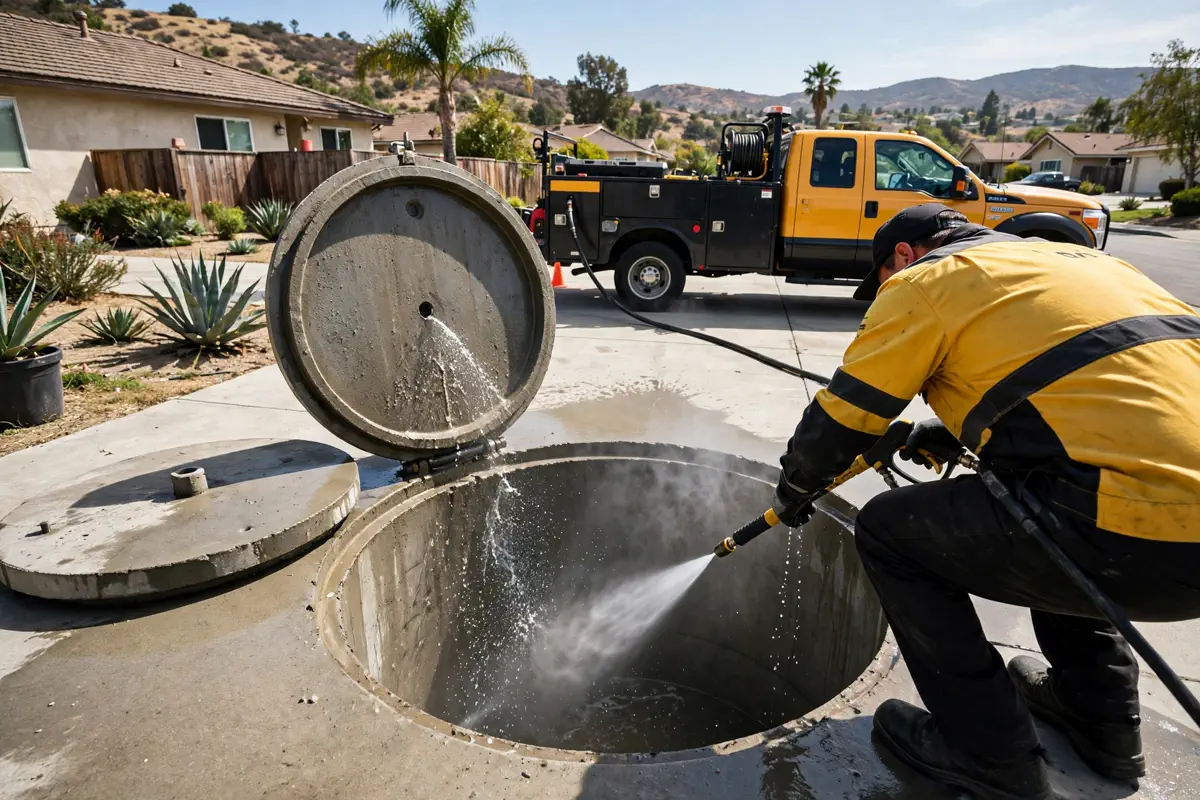
Cleaning is more than pumping. Busy Bee empties your tank, washes down the walls, clears the baffles and effluent filter, and jets the lines — a full reset that protects your drain field and keeps your system running the way it was designed to.
Request a Free Estimate
Get a fast response for your Septic Tank Cleaning
Why Ventura County Chooses Busy Bee for Septic Tank Cleaning
A tank that is only half-emptied is a problem waiting to return. We clean thoroughly, inspect as we go, and explain what we find in plain language — so you know exactly what your system needs and why.
A Real Cleaning, Not Just a Pump
We pump the tank, then wash down the interior walls and floor so built-up residue does not go straight back into service.
Baffles and Filter Checked Every Time
Inlet and outlet baffles and the effluent filter get inspected and cleaned on every visit, because those small parts protect the whole drain field.
Jetting and Camera Inspection
When lines are slow or suspect, we use hydro-jetting to clear buildup and a camera inspection to see exactly what is happening underground.
Open 24 Hours
Routine cleanings on your schedule and urgent help when a backup cannot wait. Call any time, day or night.
Septic Tank Cleaning vs. Pumping: What Is the Difference?
Pumping and cleaning are related, but they are not the same service, and the difference matters. Pumping removes the contents of the tank — the sludge layer from the bottom and the scum layer from the top — using a vacuum truck. It is the routine maintenance every septic system needs, and for a tank that is on schedule, it is usually enough. Cleaning goes further. After the tank is pumped, the interior walls and floor are washed down, the inlet and outlet baffles are cleared and inspected, the effluent filter is removed and cleaned, and the lines are checked for buildup. Pumping empties the tank; cleaning restores it.
A full septic tank cleaning from Busy Bee follows a clear sequence. First we locate the tank and open the riser lids, then we measure the sludge and scum layers so we know what we are dealing with. Next we pump every compartment of the tank completely. With the tank empty, we wash down the interior surfaces, clear the baffles, and remove the effluent filter for a thorough cleaning. If the outlet line or the distribution lines show signs of buildup, we use hydro-jetting — high-pressure water — to scour the inside of the pipes. When something looks wrong underground, a camera inspection shows us the inside of the line in real time.
There are clear signs your tank needs cleaning rather than a simple pump-out. Drains are slow throughout the house even after a recent pump-out. Toilets gurgle or flush weakly. You smell sewage near the tank or the drain field. The effluent filter clogs again soon after being cleared. The tank has not been serviced in many years, or you have just bought a home and have no service records at all. A new homeowner with an unknown tank history should always start with a cleaning and inspection, because the tank may hold years of accumulated residue and the baffles may be damaged without any visible sign.
Your drain field is where the cleaned water goes, and understanding it helps you understand why cleaning matters. After the tank, effluent flows through the distribution box — the D-box — which splits the flow evenly among the leach lines buried in the soil. The soil absorption area then filters the effluent as it percolates down through the ground. That process only works if the effluent arriving from the tank is reasonably clear. When the tank is full of solids, or the effluent filter is clogged, solids reach the leach lines and form a biomat — a slimy layer that seals the soil and stops absorption. Some Ventura County properties use a seepage pit instead of, or in addition to, a leach field: a deep, lined pit that lets effluent percolate into the surrounding soil.
How often should a septic tank be cleaned? For most homes, a full cleaning is needed far less often than a pump-out. A tank that is pumped every three to five years and used normally may only need a full cleaning every other pump-out, or when signs of trouble appear. A tank with a garbage disposal, a large household, or a history of wipes and grease going down the drains will need cleaning more often. The cost of cleaning depends on tank size in gallons, access, and condition: a buried tank without surface risers takes longer to open, and a neglected tank with hardened sludge or a clogged filter needs more time and often jetting. Septic-safe toilet paper is fine, but wipes are not, even those labeled flushable.
- Locate the tank and open the riser lids
- Measure sludge and scum layers before pumping
- Pump all compartments completely
- Wash down interior walls and floor
- Clear and inspect inlet and outlet baffles
- Remove and clean the effluent filter
- Hydro-jet lines when buildup is present
- Camera inspection when something looks wrong underground
- Check the drain field and report the full condition
A Quick Pump-Out vs. a Full Cleaning
Both services have their place. Here is how they compare, so you can choose the right one for your tank.
| Service Aspect | Waiting or DIY | Busy Bee Septic |
|---|---|---|
| What is removed | Sludge and scum are pumped out; residue stays on the walls and baffles. | ✓ Contents are pumped out and interior surfaces are washed down, so residue does not stay behind. |
| Baffles and filter | Checked only if the technician can see them; often left as they are. | ✓ Baffles are cleared and inspected and the effluent filter is removed and cleaned on every cleaning. |
| Lines and flow | Lines are not flushed, so slow buildup in the outlet and leach lines remains. | ✓ Hydro-jetting clears buildup and a camera inspection shows the true condition of the lines. |
| Best for | A tank on a regular schedule with no signs of trouble. | ✓ Overdue tanks, new-home purchases with no records, recurring clogs, and early warning signs. |
| Drain field protection | Good basic protection when done on time. | ✓ Stronger protection, because a clean filter and clear baffles keep solids out of the leach lines. |
How Septic Tank Cleaning Works With Us
Four simple steps, from your first call to a tank that is clean, inspected, and ready to serve.
Call or Request a Quote
Call (805) 307-3409 or send a quote request. Tell us your tank size, your household, and when the tank was last serviced — or if you simply do not know.
Get a Free Estimate
We explain the difference between pumping and cleaning for your situation and what affects the cost — tank size, access, and condition.
On-Time Service
Our technician arrives on schedule, pumps the tank, washes it down, cleans the baffles and filter, and jets or scopes the lines when needed.
Done Right
We leave the site clean, report the full condition of the tank and lines, and set your next service date based on what we actually found.
Does Your Tank Need More Than a Pump-Out?
If your drains are slow, your filter keeps clogging, or your tank has gone years without service, a full cleaning is the right call. Contact Busy Bee Septic Tank Pumping for a free estimate — open 24 hours, serving all of Ventura County.
Request Your Free EstimateFrequently Asked Questions
Find immediate answers about this septic service in Camarillo and Ventura County.
How expensive is it to clean out a septic tank? +
Can you sell a house with a non-compliant septic tank? +
What is the average lifespan of a septic tank? +
Can I flush toilet paper with a septic tank? +
What is the difference between septic tank pumping and septic tank cleaning? +
How often should a septic tank be cleaned? +
Busy Bee Septic Tank Pumping
Areas We Serve in Ventura County
From our Camarillo base at 465 Carmen Dr Ste C, we serve homes and businesses across Ventura County, including Camarillo, Ventura, Oxnard, Thousand Oaks, Simi Valley, Moorpark, Santa Paula, and Fillmore — day and night, seven days a week.